10 Best Business Travel Management Companies in 2026

TL;DR
Global business travel spending will hit $1.71 trillion in 2026, but costs are rising 7.2% while trip volume grows just 1.3%. Picking the right business travel management company can cut costs 15 to 30 percent. This guide compares 10 options across four categories: enterprise TMCs (Amex GBT, BCD Travel, SAP Concur), tech-first platforms (Navan, TravelPerk, ITILITE), SMB-focused managed travel (Corporate Traveler, Routespring, Engine), and consolidator concierge agents like PixelPath Travels for budget-first teams that need human help without platform commitments.
Why Business Travel Management Companies Matter More Than Ever
Business travel spending is forecast to reach a record $1.71 trillion in 2026, a 7.2% increase from the previous year. But here’s the number that should concern every travel manager: trip volume is only growing 1.3%. Companies are spending more on fewer trips. Rising transportation costs, not more travel, are driving that growth.
This cost-per-trip squeeze makes choosing the right business travel management company a financial decision, not just a logistical one. The right partner can cut costs by 15 to 30 percent while eliminating administrative overhead. The wrong one (or worse, no partner at all) leaves money on the table every time someone books a flight.
The off-platform booking problem compounds this. Research from the State of Corporate Travel and Expense 2026 found that 80% of business travelers sometimes book outside company tools, putting negotiated rates, policy compliance, and duty-of-care visibility at risk. Only 49% say they always use corporate booking tools.
Whether you’re a 5,000-person enterprise or a 10-person startup sending founders to client meetings, the question isn’t whether you need travel management. It’s which kind.
Browse current fare deals to see what consolidator pricing looks like in practice.
What Is a Business Travel Management Company?
A business travel management company (often called a TMC) handles corporate travel booking, policy enforcement, expense tracking, and traveler support. Unlike a traditional travel agency that helps individuals plan vacations, a TMC is built around organizational needs: spend visibility, compliance, negotiated rates, and duty of care.
Three distinct models have emerged:
Legacy TMCs operate through agent-assisted bookings, negotiated airline and hotel contracts, and deep integrations with enterprise systems. Think Amex GBT or SAP Concur.
Tech-first platforms prioritize self-service booking with software that enforces travel policies automatically. Navan and TravelPerk are the leading examples.
Consolidator and concierge agents use human advisors to source unpublished and consolidator fares, charging per ticket rather than through subscriptions. This model works especially well for smaller teams that don’t meet the thresholds enterprise TMCs require. To understand how consolidator pricing differs from published fares, this explainer on unpublished airfares covers the mechanics.
Quick-Reference Comparison Table
| Company | Best For | Starting Price | Pricing Model | Rating | Key Strength | Key Limitation |
|---|---|---|---|---|---|---|
| PixelPath Travels | SMEs, India-route flyers, budget-first teams | Pay per ticket | Zero booking fees | Boutique/concierge | Human-researched consolidator fares; 24/7 WhatsApp | No self-booking platform |
| Navan | Mid-market tech (50-2,000 emp.) | Free (travel) | Freemium + per-user | 4.7/5 (8,140 G2) | All-in-one T&E + cards | Support quality polarized |
| TravelPerk | SMBs 10-250 emp. | Free (5 bookings/mo) | % per booking + tiers | 4.6/5 (1,548 G2) | Transparent pricing; huge inventory | Premium features gated |
| ITILITE | Mid-market 50+ emp. | $10/trip | Per-trip | 4.6/5 | AI-powered policy enforcement | Limited enterprise proof |
| SAP Concur | Enterprises 1,000+ emp. | $9-$24/user/mo | Hybrid per-user + per-transaction | Legacy leader | Deep ERP integration | Complex pricing; high implementation cost |
| Amex GBT | Global enterprises + govt | $5-$50/booking | Per-transaction contract | Market leader by volume | Post-CWT scale; $2.7B revenue | SMB-unfriendly |
| BCD Travel | Multinationals with ESG needs | Custom | Contract-based | Enterprise-grade | Sustainability tracking via Advito | Traditional model; long implementation |
| Corporate Traveler | SMEs under 100 emp. | Custom | Managed service | Positive reviews | 10-second response SLA | Hidden fee concerns in some reviews |
| Routespring | Budget-conscious SMBs | Custom | Platform-based | Emerging | Unified platform approach | Smaller market presence |
| Engine | Hotel-heavy programs | Free | Commission-based | 4.4/5 (23 G2) | $322M saved in 2026 | Hotel-first; flight/car newer |
Category 1: Enterprise TMCs (1,000+ Employees)
These business travel management companies serve large organizations that need global coverage, ERP integration, and dedicated account teams. Transaction fees typically range from $20 to $60 per online booking and $50 to $150 per agent-handled booking, according to ARC industry data.
1. SAP Concur
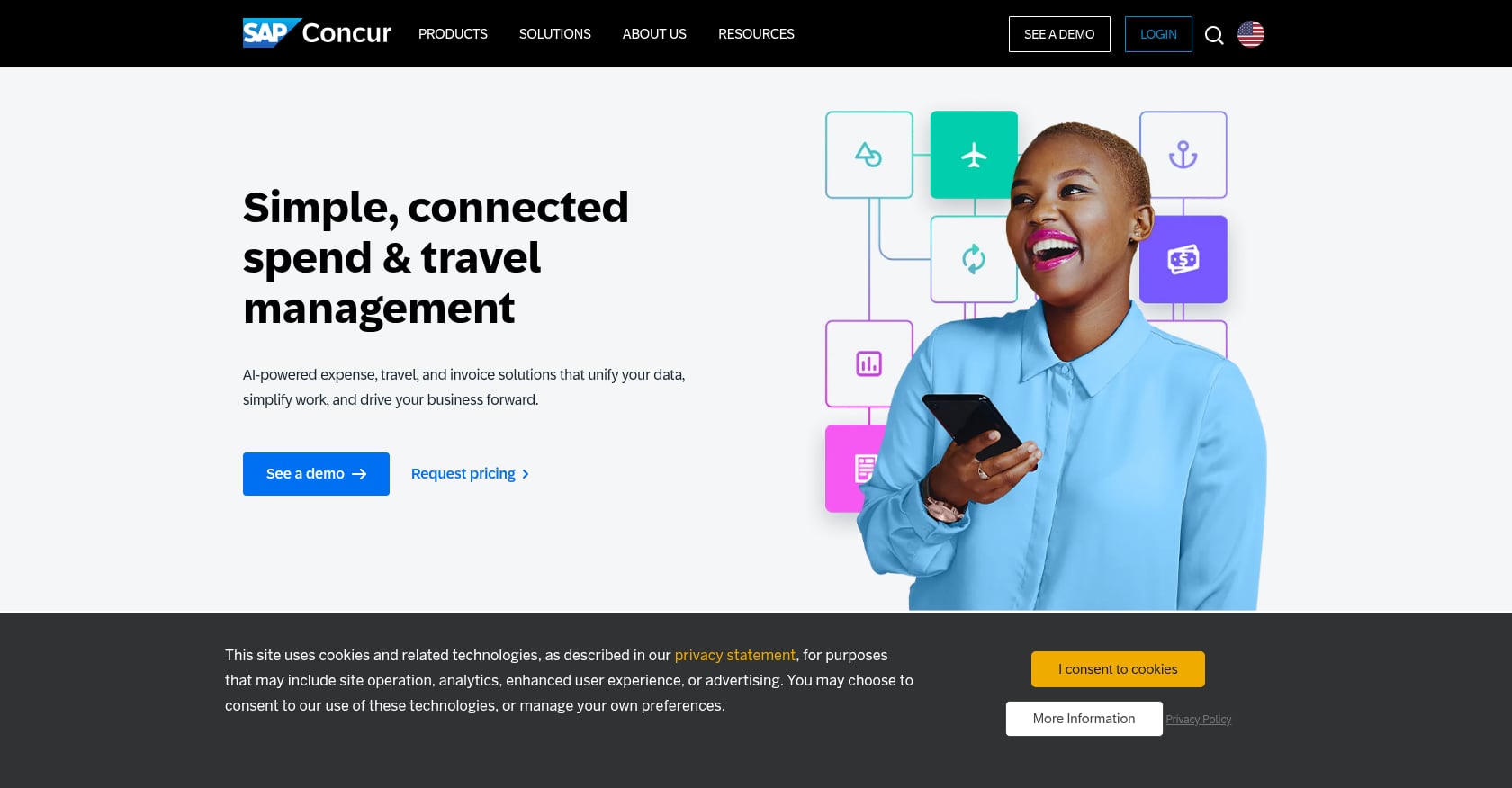
Best for: Large enterprises needing deep ERP integration across travel, expense, and invoice processing.
Pricing:
- Concur Expense: $9 to $24 per active user per month
- Concur Travel: $3 to $8 per active user per month
- Per-booking fees: $15 to $25 per air transaction, $8 to $15 per hotel transaction
- Minimum annual commitment of $30,000
Key features:
- Processes more than 2 million NDC travel transactions
- Supports business travel programs across more than 150 countries
- Integrates natively with SAP ERP and other enterprise finance systems
- Comprehensive policy enforcement and approval workflows
Tradeoffs:
- Implementation complexity adds 25 to 40% to first-year costs
- Uses a hybrid pricing model that varies by module, making apples-to-apples comparison with competitors deliberately difficult
- Overkill for companies under 500 employees
- The learning curve for administrators is steep
SAP Concur is the default choice for enterprises already running SAP infrastructure. Everyone else should think carefully about whether the integration benefits justify the complexity.
2. Amex GBT

Best for: Global enterprises and government programs requiring worldwide coverage and agent-assisted service.
Pricing:
- Online booking fees: roughly $5 to $25 per transaction
- Agent-assisted bookings: $25 to $50 per transaction
- Custom contracts for large programs
Key features:
- Acquired CWT in a $540 million transaction, creating the world’s largest TMC
- Generated revenues of over $2.7 billion in 2025, up 12% year-over-year
- Returned to profitability with $111 million net profit in 2025 after a $134 million loss in 2024
- In May 2026, announced a definitive agreement to be acquired by Long Lake Management for approximately $6.3 billion
Tradeoffs:
- CWT integration is still ongoing through 2026, which may cause service disruptions
- Minimum spend and employee thresholds exclude most SMBs
- Agent quality can vary by region
- The platform experience lags behind tech-first competitors
The Long Lake acquisition adds uncertainty. Companies signing multi-year contracts should negotiate flexibility clauses.
3. BCD Travel
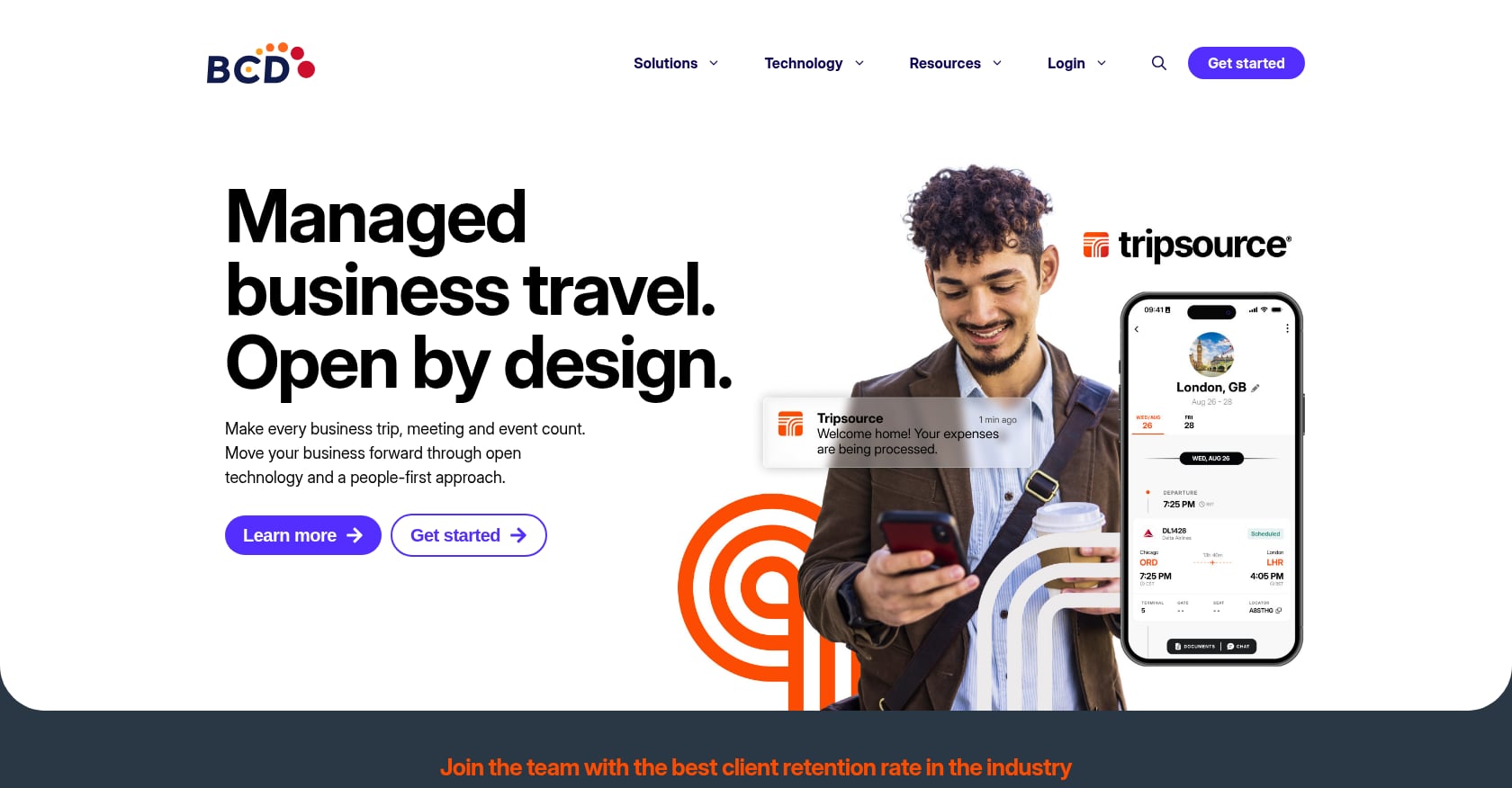
Best for: Multinationals with ESG reporting requirements and complex, multi-region programs.
Key features:
- Operates across 170 countries
- Advito consulting arm provides sustainability tracking and advisory services
- Strong data analytics and benchmarking capabilities
- Carbon footprint reporting built into the platform
Tradeoffs:
- Traditional TMC model with longer implementation cycles
- Self-serve booking options require significant setup
- Pricing is fully custom and opaque until RFP stage
- Less suited for companies under 500 travelers
BCD Travel is a strong fit for organizations that need to report on travel emissions alongside cost data. The Advito consulting practice differentiates it from pure booking platforms.
Category 2: Modern Tech-First Platforms (50 to 1,000 Employees)
These platforms combine self-service booking with automated policy enforcement and integrated expense management. They’re designed for mid-market companies that want control without the overhead of a traditional TMC relationship.
1. Navan
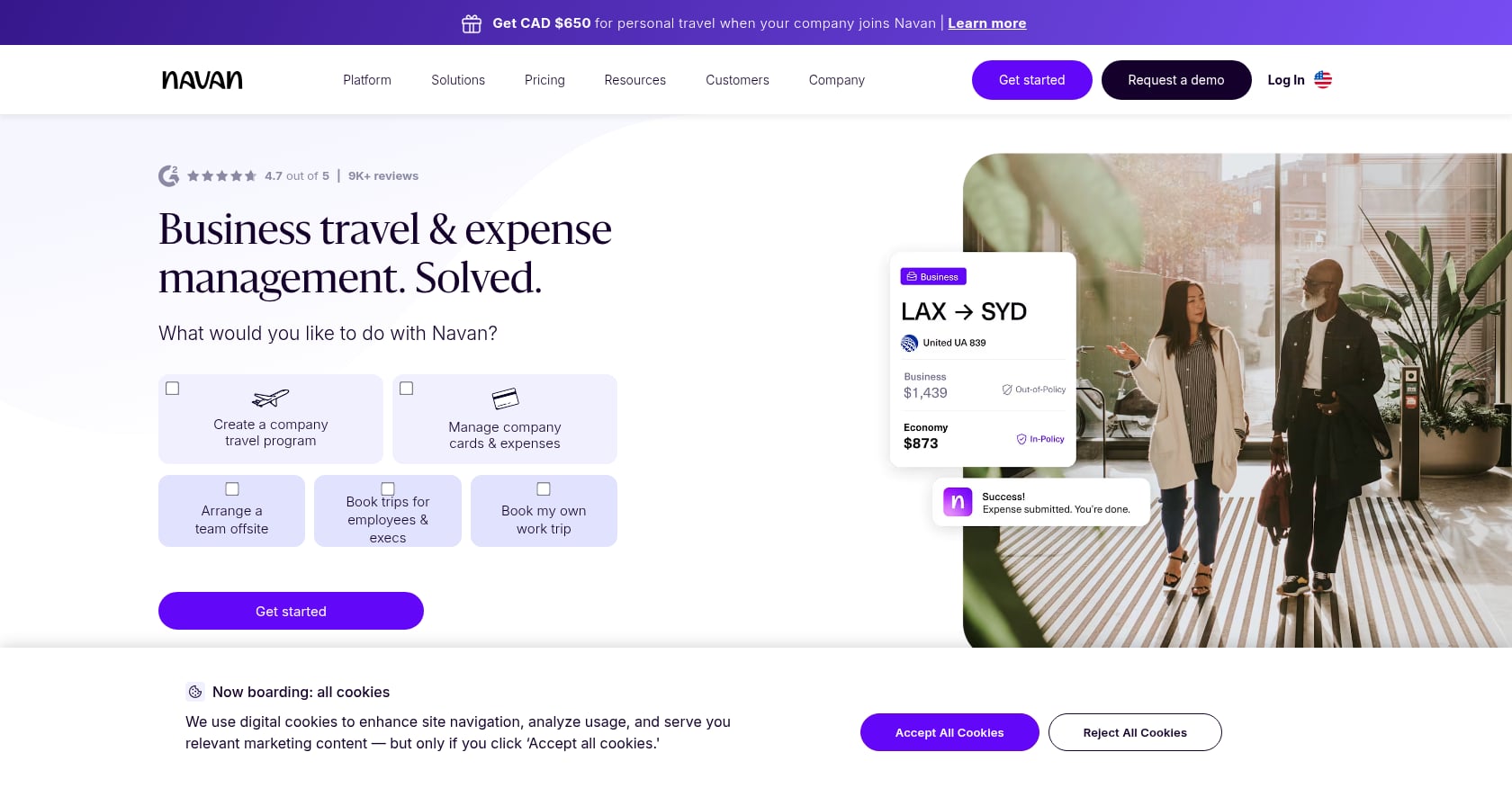
Best for: Mid-market tech companies wanting unified travel, expense, and corporate cards in one platform.
Pricing:
- Travel booking: free (no trip limit for companies with 300 or fewer employees)
- Expense management: free for first five users, then $15 per user per month
- Larger companies get custom pricing with volume tiers
Key features:
- Publicly traded on Nasdaq since October 2025
- $9.1 billion in annual gross booking volume across 10,000+ companies
- 4.7 out of 5 on G2 with 8,140 reviews
- Policy enforcement at point-of-sale
- Loyalty program integration preserving traveler status and miles
Tradeoffs:
- Support quality is deeply polarized in reviews
- Complex setup for very small teams (under 20 employees)
- Opaque pricing at enterprise scale
What users actually say: TrustRadius reviewers report significant difficulty exiting Navan contracts. One reviewer described months of trying to close their account: “We tried to leave Navan, turned off all our employees’ physical cards and deleted every user account… After we requested to close out our account, we never heard back despite reaching out 4 times. Then we started seeing charges to our employees’ cards that we had deactivated.” Capterra reviewers have also flagged double-billing issues on flight bookings, with one noting a single Delta/Air France flight was initially billed three times.
Navan’s free tier is genuinely useful for companies under 300 employees. But the support complaints are consistent enough that any company evaluating Navan should test the support experience during their trial period, not after signing.
2. TravelPerk
Best for: SMBs with 10 to 250 employees, particularly those with European-heavy travel routes.
Pricing:
- Starter: free for up to 5 bookings per month, then 5% per booking
- Premium: $99 per month
- Pro: $299 per month
Key features:
- Access to over 1.8 million accommodation properties
- Integrates low-cost carrier content from airlines like Ryanair and easyJet
- Automatic flight rebooking without additional charges
- Cashback of up to 2.5% on bookings
- 4.6 out of 5 on G2 with 1,548 reviews
Tradeoffs:
- Customized travel reports and negotiated corporate rates are only available in premium plans
- Weaker on US domestic routes compared to European coverage, per user feedback
- The 5% per-booking fee on the free tier adds up quickly for frequent travelers
- Phone support is limited on lower tiers
TravelPerk’s transparent pricing is a genuine advantage. You can calculate your costs before signing anything. For European routes especially, the low-cost carrier inventory gives it an edge that Navan and SAP Concur don’t match.
3. ITILITE
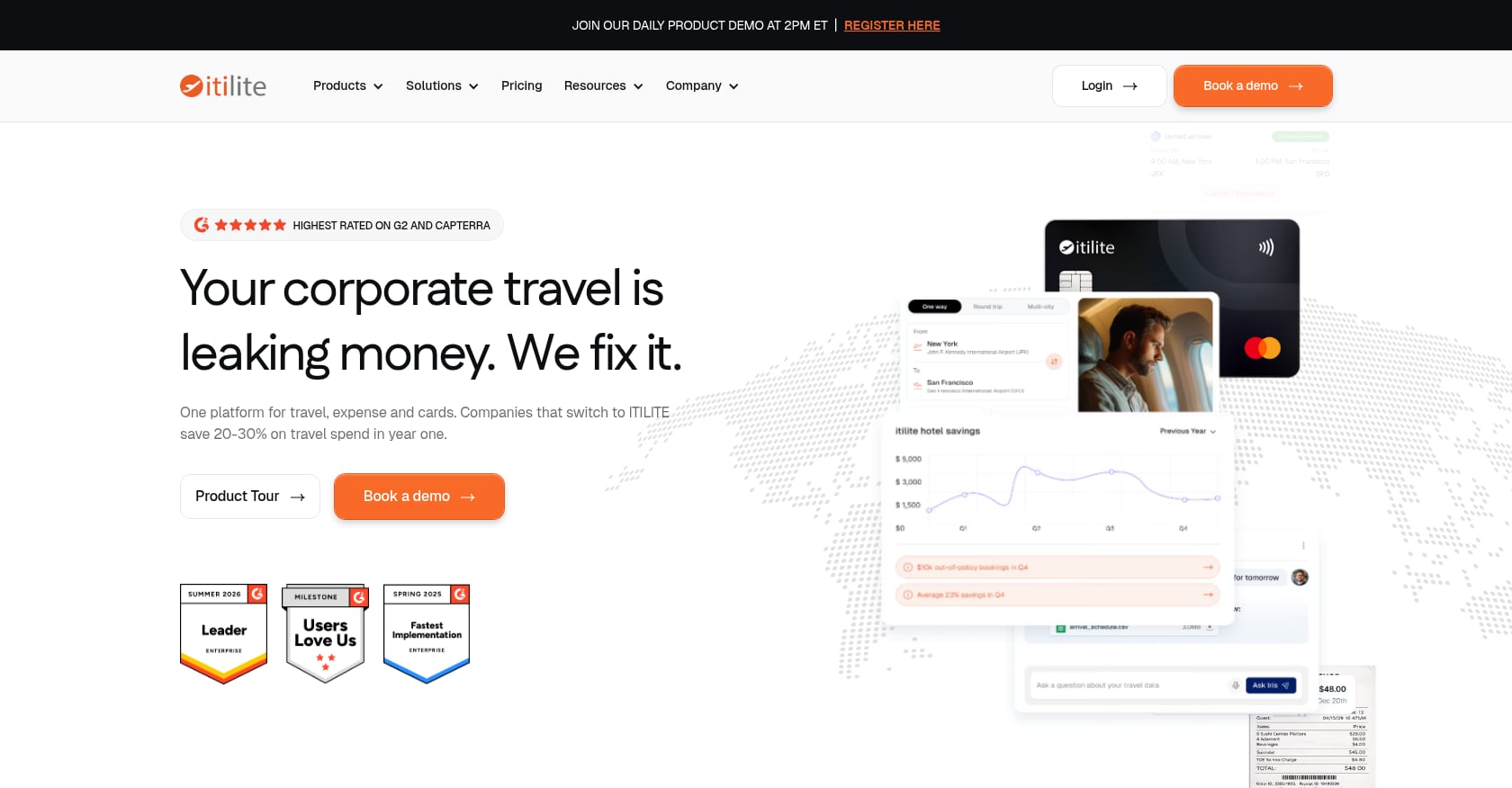
Best for: Mid-market companies with 50+ employees wanting integrated travel, expense, and corporate cards with AI-powered automation.
Pricing:
- $10 per trip for travel management
- $6 per user per month for expense management
Key features:
- AI-powered policy enforcement and auto-rebooking
- Integrated corporate cards
- Per-trip pricing keeps costs predictable
- Growing traction in the mid-market segment
Tradeoffs:
- Newer entrant with limited enterprise proof points
- Smaller integration ecosystem compared to Navan or SAP Concur
- Geographic coverage may be thinner in certain regions
ITILITE’s per-trip pricing model is refreshingly simple. For companies booking 50 to 200 trips per month, the math often works out cheaper than Navan’s per-user expense fees or TravelPerk’s percentage-based charges.
Category 3: SMB-Focused Managed Travel (Under 100 Employees)
Small and mid-size businesses face a specific challenge: they’re too busy for DIY booking on consumer sites but too small for enterprise TMC contracts. These business travel management companies target that gap.
The savings opportunity is real. According to Corporate Traveler, SMEs save up to 18% per work trip, up to 25% from corporate travel discounts, and up to 7% from travel and expense policies.
1. Corporate Traveler
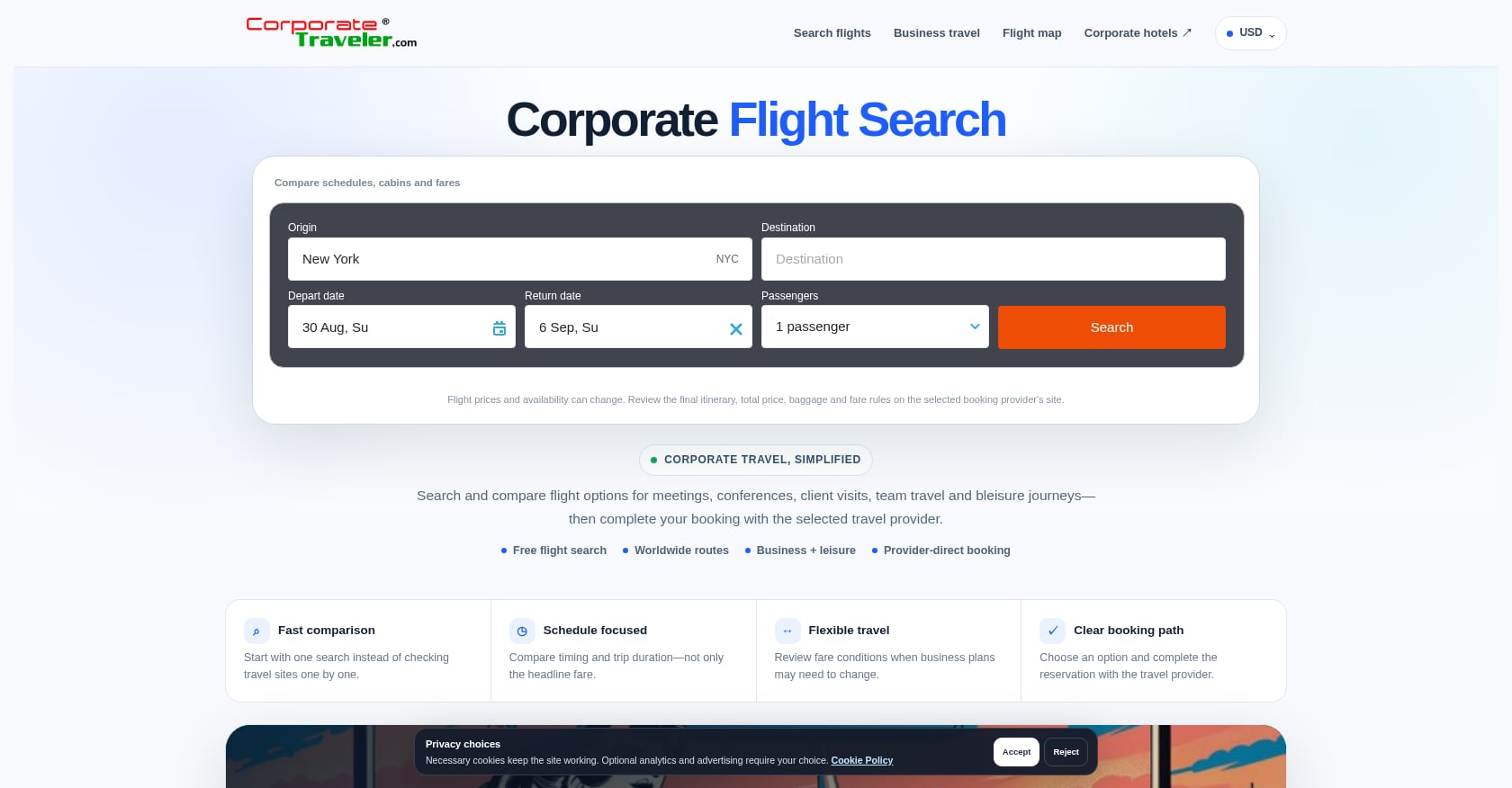
Best for: SMEs under 100 employees wanting a managed, human-led service with dedicated account management.
Pricing: Custom, based on travel volume and complexity.
Key features:
- Dedicated account managers with an industry-leading 10-second response time SLA
- Part of the Flight Centre Travel Group (strong financial backing)
- Easy rollout and smooth setup experience, per customer reviews
- Strong reporting and visibility into travel spend
Tradeoffs:
- Public reviews mention pricing discrepancies and hidden-fee concerns
- Manual cleanup is still needed for reporting exports
- Custom pricing means you can’t estimate costs before engaging sales
- Less suited for companies with very low travel volume (under 5 trips per month)
Practitioners on review platforms consistently praise Corporate Traveler’s responsiveness. The 10-second response SLA is unusual in the industry and reflects a genuine service commitment. The hidden-fee concerns are worth raising directly during contract negotiation.
2. Routespring
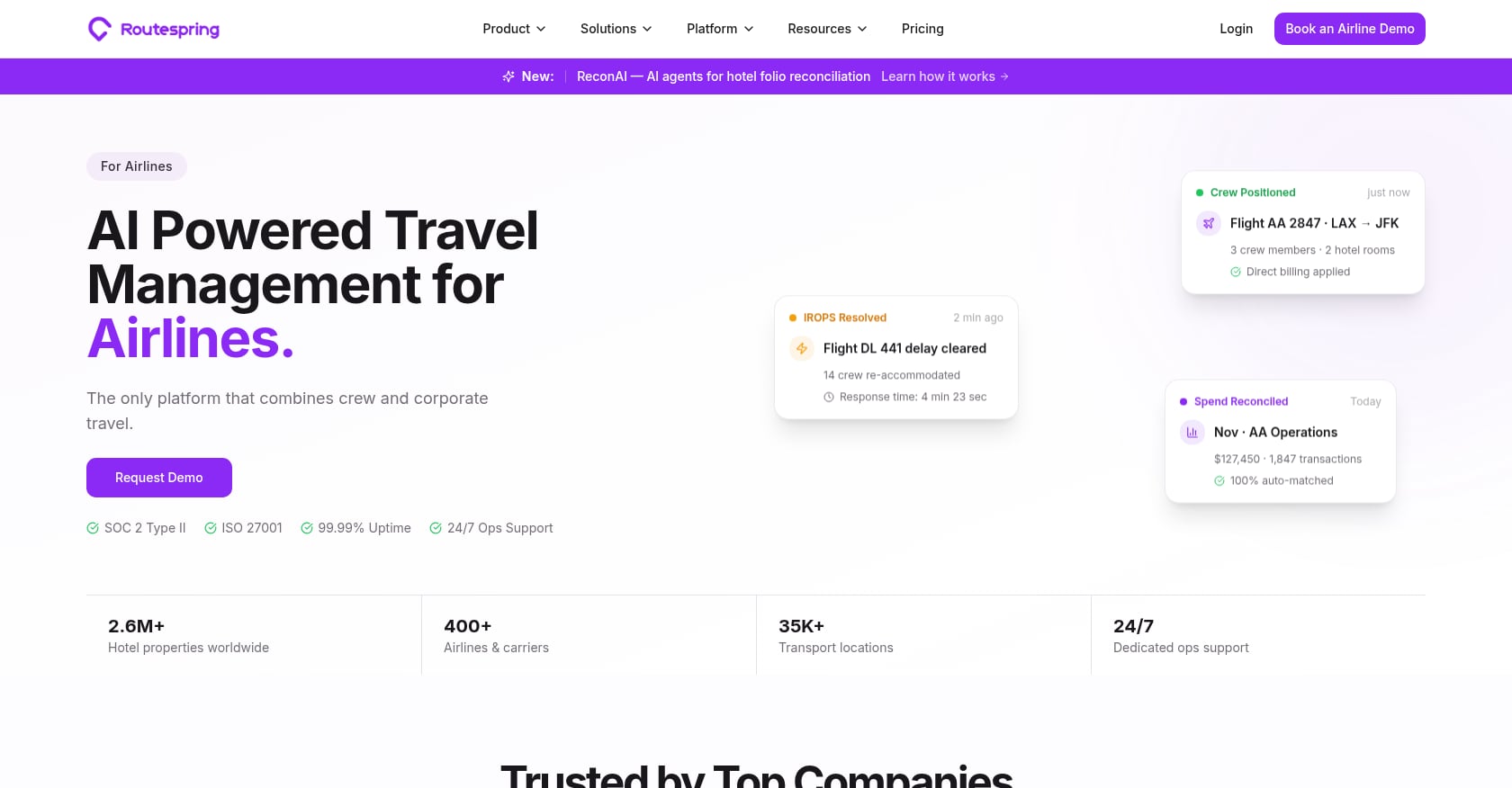
Best for: Budget-conscious SMBs looking for an affordable, modern travel management platform.
Key features:
- Positions as a “unified platform” bridging legacy TMC models and fintech disruptors
- Budget-friendly pricing designed for smaller organizations
- Policy enforcement and approval workflows
- Centralized billing and reporting
Tradeoffs:
- Smaller market presence and brand recognition
- Limited publicly available review data
- Feature set may be thinner than more established competitors
- Best for straightforward domestic travel programs
Routespring is worth evaluating if your primary need is a simple booking platform with basic policy controls at a low price point. It won’t replace a full-service TMC, but it handles the basics well.
3. Engine
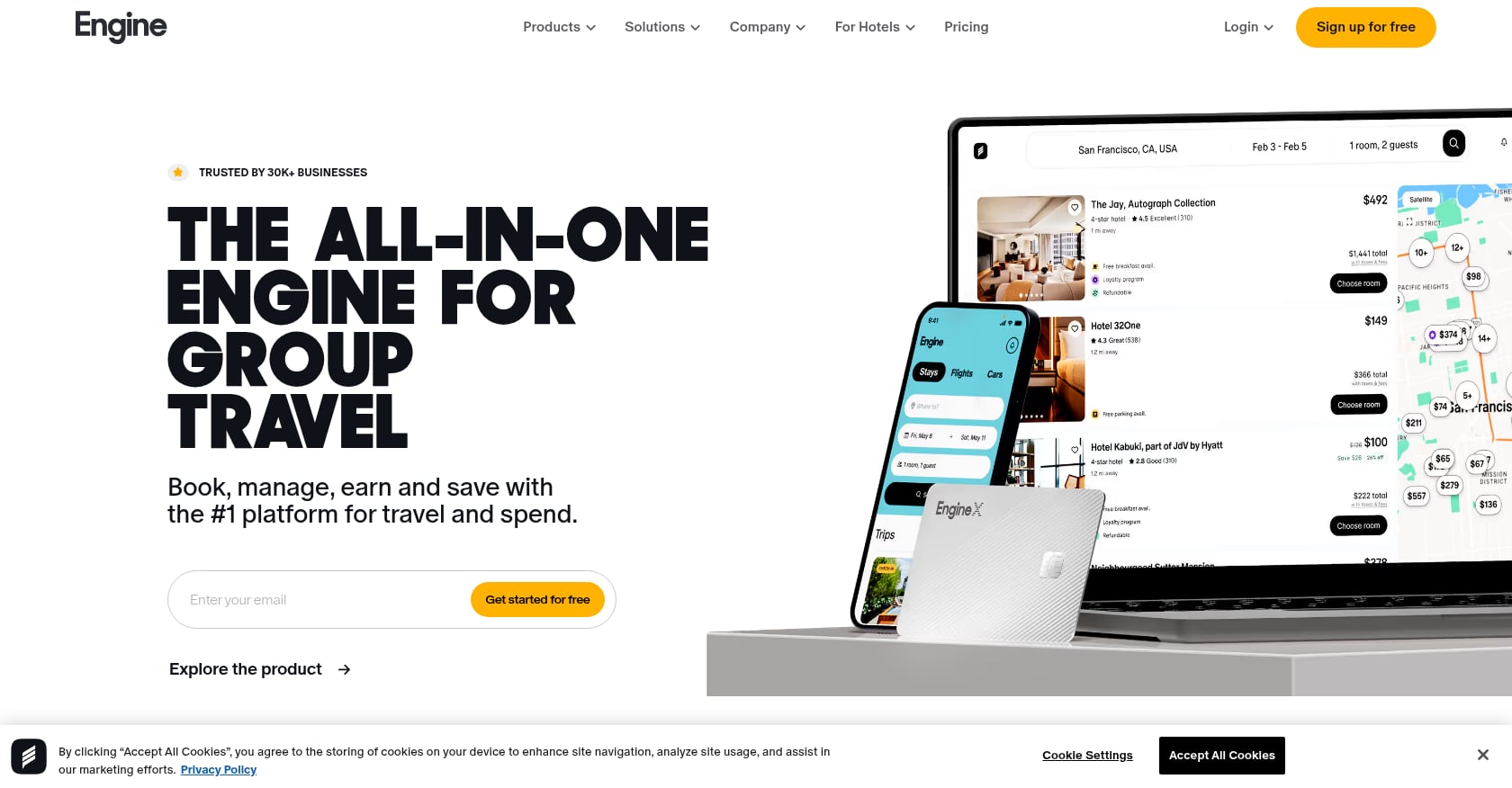
Best for: Companies where hotel spend is the primary pain point, particularly in construction, field services, and other industries with heavy on-site travel.
Pricing: Completely free. No platform fees, no membership fees, no agent-assist fees, no contracts, no minimum spend. Revenue comes from hotel commissions.
Key features:
- Companies report 12.5% average hotel savings, up to 70% in select cases
- Customers saved a combined $322.3 million in 2026
- Over 39,000 businesses booking through Engine
- 4.4 out of 5 on G2 with 23 reviews
Tradeoffs:
- Originally hotel-focused; flight and car rental booking are newer, less mature additions
- Review polarization is notable: 91% positive on G2 but only 3.0 out of 5.0 on Trustpilot
- Limited value for companies where airfare is the primary spend category
- Executive travel programs should look elsewhere
G2 users in construction and field services report the most value from Engine. If your company spends heavily on hotels and needs a free, low-friction solution, Engine is hard to beat. But if airfare is your biggest cost driver, you need a different kind of partner.
Category 4: Consolidator and Concierge Agents (Any Size, Flight-Heavy)
This is the category that no other comparison article covers, and it’s the one most relevant to small teams with 5 to 20 frequent business travelers.
Here’s the problem: companies too small for traditional TMCs but too busy for DIY booking fall into a gap. Enterprise TMCs have minimum spend thresholds. Tech platforms charge subscriptions or per-user fees that don’t pencil out for low volume. Consumer booking sites don’t enforce travel policies or provide spend visibility.
The consolidator concierge model fills this gap. Consolidators enter contracts with major carriers to sell at reduced prices to niche markets, meaning fares through consolidators will often be lower than published rates. A personalized travel advisor who sources these fares on your behalf eliminates the search overhead while capturing savings your team would never find on Expedia or Google Flights.
One important note: consolidators most commonly operate in international markets. In domestic markets, they typically only offer business class and first class tickets. Tickets purchased through consolidators may have different fare rules than published fares, and frequent flyer credits may not always accrue at the standard rate. These are honest tradeoffs worth understanding before committing.
For companies evaluating this approach, pay-per-trip models often cost less than monthly subscriptions when booking volume is under 15 trips per month.
1. PixelPath Travels
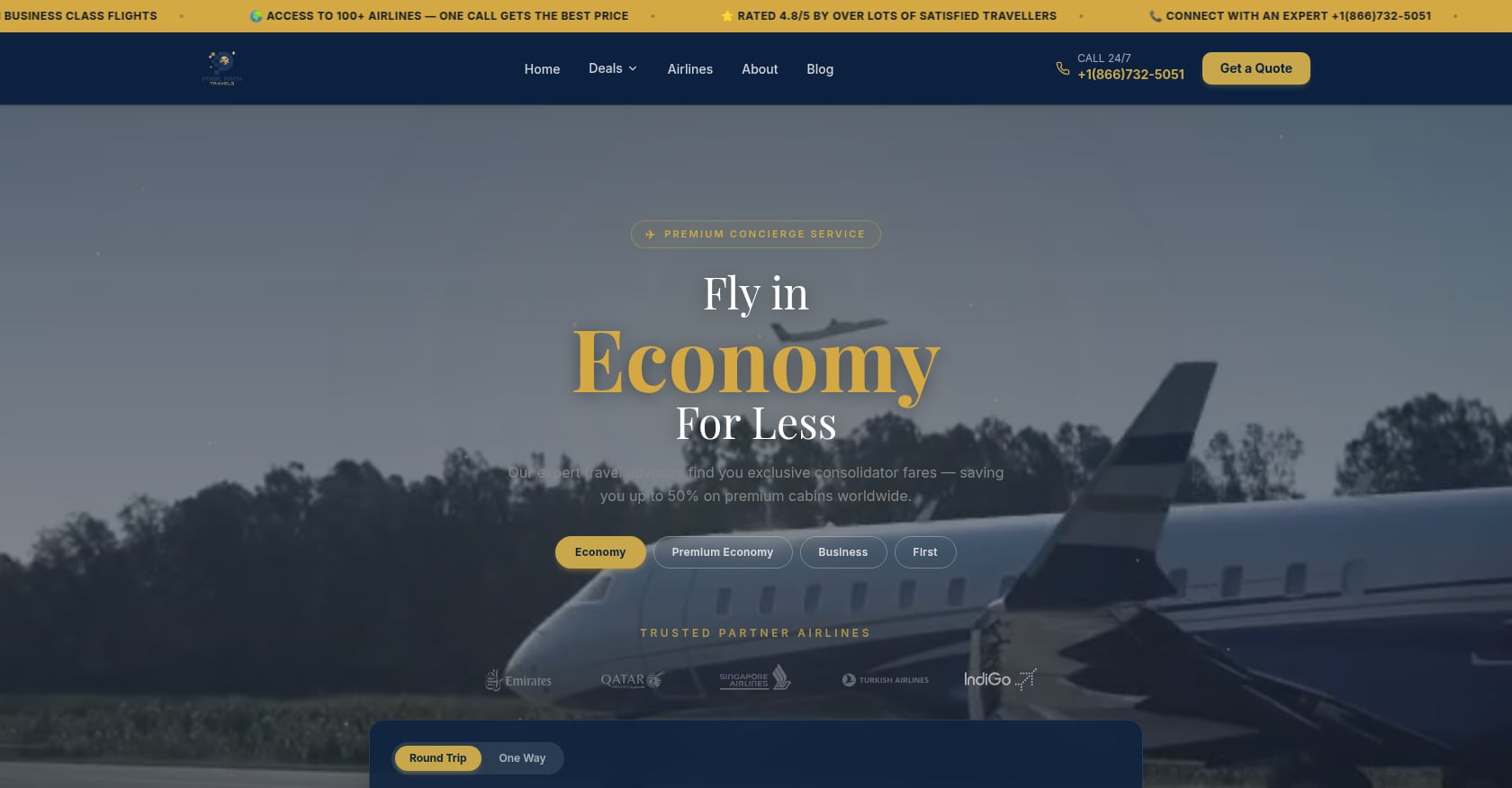
Best for: SMEs, India-route frequent flyers, and budget-first teams that want human-sourced consolidator fares without platform commitments or booking fees.
Pricing: Pay per ticket with zero booking fees. No subscriptions, no minimums, no contracts.
Key features:
- Human advisors (no bots, no algorithms) research consolidator and unpublished fares across carriers
- Quotes delivered within approximately 2 hours
- 24/7 advisor access including WhatsApp support
- Zero hidden convenience fees at checkout
- Specializes in economy fares on India routes featuring IndiGo, SpiceJet, Akasa Air, and Air India Express alongside premium long-haul carriers
- Covers economy through first class across major international airlines including Emirates, Qatar Airways, Singapore Airlines, and British Airways
- Accepts major cards and PayPal
Tradeoffs:
- No self-booking platform; all bookings are handled through phone or web form, which won’t suit companies that need instant self-service
- Fares are dynamic and subject to airline availability; no fixed prices are guaranteed until the PNR is generated
- Cancellations follow strict airline policies, and processing fees apply for refunds
- For international travel, travelers are responsible for their own visa compliance (though guidance is provided)
- Standard baggage inclusions on budget airline tickets typically cover 15kg check-in and 7kg cabin, with extra baggage requiring pre-purchase
Why this model works for small businesses: A team of 3 to 15 employees making 2 to 10 trips per month does not need a $30,000-per-year SAP Concur deployment. They need someone who picks up the phone, finds the cheapest fare on the route, and handles changes when things go sideways. That’s exactly what a concierge model delivers.
The Deloitte Corporate Travel Study 2025 found that the proportion of professionals traveling for work declined from 36% in 2024 to 31% in 2025, but remaining travelers are traveling more frequently. This makes per-trip cost optimization more critical than ever, and a pay-per-ticket model with zero platform fees aligns directly with that reality.
Explore current business class deals to compare consolidator fares against published rates.
How to Choose the Right Business Travel Management Company
The right choice depends on three factors: company size, travel volume, and your biggest pain point.
Start with company size:
- 1,000+ employees with global travel → Enterprise TMCs (Amex GBT, BCD Travel, SAP Concur)
- 50 to 1,000 employees wanting self-service → Tech-first platforms (Navan, TravelPerk, ITILITE)
- Under 100 employees needing managed service → SMB-focused (Corporate Traveler, Routespring, Engine)
- Any size, flight-heavy, budget-first → Consolidator concierge (PixelPath Travels)
Then consider travel volume:
- High volume (100+ bookings/month): subscription or per-user pricing makes sense
- Medium volume (20 to 100 bookings/month): per-trip pricing often wins
- Low volume (under 20 bookings/month): pay-per-ticket with zero platform fees is almost always cheaper
Finally, identify your top pain point:
- “We need expense integration and policy enforcement” → Navan or ITILITE
- “Our hotel spend is out of control” → Engine
- “We need the cheapest international fares possible” → Consolidator concierge
- “We need ERP integration and global compliance” → SAP Concur or BCD Travel
- “We need a human who answers the phone” → Corporate Traveler or PixelPath Travels
The 54% of travel managers who say cost is one of the top factors restricting travel should pay close attention to the pricing model, not just the sticker price. A free platform with 5% booking fees can cost more than a $10-per-trip flat rate at moderate volume.
For companies focused on economy deals and maximizing savings on every booking, the consolidator model deserves serious consideration.
Conclusion
Business travel management companies exist on a spectrum from global enterprise TMCs processing billions in bookings to boutique concierge agents sourcing a single fare for a founder flying to a client meeting. The right fit depends entirely on your organization’s size, volume, and priorities.
The macro trend is clear: with spending up 7.2% and trip volume barely moving, every company needs to optimize cost per trip. Whether that means deploying Navan’s all-in-one platform for a 500-person tech company or having a human advisor find the lowest consolidator fare for a 10-person team, the goal is the same. Spend less, travel smarter.
For teams that want human-researched fares with zero booking fees and no platform commitments, explore PixelPath Travels’ current deals to see what consolidator pricing looks like for your routes.
Frequently Asked Questions
What is a business travel management company?
A business travel management company (TMC) is an organization that handles corporate travel booking, policy enforcement, expense tracking, and traveler support on behalf of businesses. Unlike consumer travel agencies, TMCs are built around organizational needs like spend visibility, negotiated rates, compliance, and duty-of-care obligations. They range from global enterprise operations like Amex GBT to boutique concierge agents that source fares on a pay-per-ticket basis.
How much do business travel management companies charge?
Pricing varies widely by model. Enterprise TMCs typically charge $20 to $60 per online booking and $50 to $150 per agent-handled booking. Tech platforms like Navan offer free tiers with per-user fees ($15/user/month for expense management). SAP Concur starts at $9 to $24 per user per month with a $30,000 annual minimum. Concierge agents like PixelPath Travels charge per ticket with zero booking fees and no subscription.
Do small businesses need a TMC?
Not necessarily a traditional TMC, but some form of managed travel is valuable once a company makes more than a handful of trips per month. SMEs save up to 18% per work trip with managed programs. For small teams (under 20 employees), a consolidator concierge or a lightweight platform like Engine often makes more sense than an enterprise TMC with minimum-spend requirements.
What is the difference between a TMC and a travel booking platform?
A traditional TMC provides human agents, negotiated contracts, and full-service management. A travel booking platform (like Navan or TravelPerk) offers self-service booking with automated policy enforcement and expense integration. Some companies, like Corporate Traveler, blend both approaches. The concierge model adds a third option: human advisors sourcing fares without the overhead of a full TMC contract.
What are consolidator fares and how do they work for business travel?
Consolidators purchase airline tickets in bulk at discounted rates through contracts with carriers, then pass savings to travelers. These fares are often lower than published rates, particularly on international routes. The tradeoff is that fare rules may differ from standard tickets, frequent flyer accrual isn’t always guaranteed at full rates, and availability is dynamic. Consolidator fares work especially well for companies with international travel needs and budget sensitivity.
How do I know if my company is too small for an enterprise TMC?
Most enterprise TMCs (Amex GBT, BCD Travel, SAP Concur) have minimum spend thresholds, often $30,000 or more annually. If your company has fewer than 50 employees or books fewer than 20 trips per month, you’ll likely get better service and pricing from an SMB-focused option like Corporate Traveler, a tech platform like TravelPerk, or a pay-per-ticket concierge agent.
Why do 80% of business travelers still book off-platform?
According to the 2026 State of Corporate Travel and Expense report, the main reasons include better prices on consumer sites, familiarity with personal booking tools, friction in corporate booking platforms, and lack of training on company tools. This off-platform booking puts negotiated rates, policy compliance, and traveler safety visibility at risk, which is precisely why choosing a user-friendly business travel management company matters.
Can a business travel management company help with India routes specifically?
Yes. Several options serve India routes, but coverage varies. TravelPerk has stronger European coverage. Navan covers major international routes broadly. For companies with frequent US-to-India travel, PixelPath Travels specializes in India routes with fares on carriers like IndiGo, SpiceJet, Akasa Air, and Air India Express, alongside premium long-haul options on Emirates, Air India, and others.